
Really generous review over at http://slothrop.com/ by Phil Jourdan: after his American adventures, I’m amazed he has the energy to write/review anything:
Author: DavidWebster
“A Dispirited visit to Waterstones”
Over on his The ‘God Blog’, Mel Thompson considers Dispirited in the light of a visit to Waterstones.
You can read the full piece over on his blog, but I was taken by his experience of looking for the Philosophy section of the bookshop:
One small section of shelving was labeled ‘Religions’ and it had a small selection of introductory titles, a modest selection of Bibles and prayer books, and displayed on the top, Alain de Botton’s Religion for Atheists. So far so predictable. But next to those shelves was a huge block, three times as wide, devoted to the assorted nonsense called ‘Mind, Body, Spirit’ – the ever-expanding MBS of publisher/bookshop-speak. But where was the Philosophy section? Tucked in the corner was a category called ‘Smart Thinking’, which did (thankfully, if I’m to supplement my modest pension) have a copy of my Understand Philosophy, along with some of the usual popular philosophy suspects, along with advice of perking up your capacity to think.
Philosophy seemed to have morphed into another aspect of MBS – when you’ve tried all the other spiritual therapies, how about perking up your mental abilities too! All part of the spiritual supermarket; pick and mix and don’t think about any of it for too long!
This seems to match my experience, and I wonder if others have encountered the same…
Death, Unicorns and Haters..
A number of possible blog topics seem to be possible today. I could talk about the recent Religion Dispatches interview – and all the negative comments, there and elsewhere, in response (more positive was this one). I won’t – some commenters make useful points, but many seem to have only read the first line or two. I think it best to edge away from responding to every comment made – and re-engage with ones that seem actually interesting in a few months, as dust settles. [Though it may be worth quoting the opening of the book – as people seem to think I am actually threatening violence: When… …I want to punch their face. Hard. But I don’t; partly because it is a poor way to recruit students, and also because it is probably wrong. And I am a coward who fears retaliatory pain. There is no threat here people!]
The other topic, as those who follow me on twitter will know, is an obsession (though I am now recovering a little) with Unicorn Healing – and claims such as this one:
Unicorns have agreed for the first time to join with a human healer in helping us remove negative energy from our earth.
But I’ll leave that alone too. What I did want to look at was death. A number of those who do (or will, I anticipate, knowing some of the destinations of review copies) object to the book have done so on the grounds that either (a) I can’t be sure that we don’t survive death or (b) we do survive death. As those who’ve read the book will know – I am fairly emphatic:
The end is what death is. It is its fullness of meaning. Its end-ness is what inhabits the concept most fully. To repeat the mantra of non-end-ness to death is to stand with eyes closed, fists clenched and to scream against a hurricane. The new age approach is to dwell beneath a duvet of (self)deception and hope that the dawn’s fresh light will chase away the demons. The demon of death is not scared of daylight though, and walks proud through our circles of protection; lord of nature, rather than repelled by it.

I stand by this. To accept any other view is to allow for a life where death takes on a different value: and therefore one where life does also. Even if we allow an epistemological wobble here – and demand that I concede that life-beyond-death may be possible, I am not sure this matters. Even though the burden of proof ought to be elsewhere, we might concede the possibility. But does it matter if we do so? I would argue that it does not. In the absence of evidence (and if NDEs are the best we have, that is looking fairly flimsy) that is clear – perhaps a better way to put my view here, is that we should live as if death is absolute and total annihilation of all we are and ever could be.
We can still concede it as possible that it could be otherwise – but knowing nothing of it, that mere possibility, with so little to seem to commend it, seems to do nothing to alter the existential realities we know that we do face.
Religion Dispatches Interview

In case people are interested there is an interview with me, about Dispirited, now up on the Religion Dispatches Magazine web site: HERE
Cheers, Dave.
All Paths are Valid?
I was reading about The School of the Living Light, which “focuses on spiritual development, meditation, channelling and healing courses.” I shouldn’t, I know. But I was. It contains much of the usual blend of reiki, channelling, healing and ‘ascension’. But what I also noted was this text:
There are many paths to spiritual growth and transformation, all of them valid, we are simply offering one way, it may be your way.
This seems to directly reflect a theme I explore in Dispirited. The claim that of the many paths: “all of them are valid”. I am always nonplussed by this. Does that mean that all Spiritual paths are effective? That none don’t work? Is valid here a synonym for ‘true’? Or for ‘efficacious’? This is how I address this in the book:
Across the spectrum of contemporary spirituality, the question of: “yes, but who is right? Which account of reality has more explanatory and predictive power than others?” is set aside, often in the name of inclusivity or liberal openness. But inclusivity of belief is not belief at all, but a posture of un-truth, of not knowing even what truth is. The seemingly benign world of spiritual syncretism, particularly in the new-age movement, is a blend of arrogance and nervousness. Arrogance regarding somehow have transcended the need for demonstrating the full basis and rationale for beliefs, and nervousness about actually being called upon to do so, especially when having invoked half-understood concepts imported from science or philosophy.
I am still fairly confident that this isn’t too harsh. Reading the page at http://schoolofthelivinglight.co.uk/classes-workshops/what-is-the-light-body/ there is this section:
wakening your light body creates a level of harmony, aligning your physical, emotional, and mental energy bodies so that your spiritual shimmer is activated. In a series of three workshops you will work with the seven centres that affect them. (These are not chakras).
If the seven centres that impact your ‘bodies’ are not your chakras – do you still have chakras? Do they conflict? Do we have both? Which is true – this or a chakra-based account? They are invoked at http://schoolofthelivinglight.co.uk/downloads/chakra-meditations/ so it seems we have both.
My aura is starting to feel a little overcrowded…
Book news
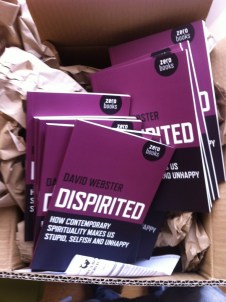
In exciting news – copies of Dispirited arrived from the publishers this morning. Amazon and other booksellers should be getting copies very soon. In fact Amazon US is showing the book as in stock…
Nothing more to add – was just excited to get my hands on a physical copy!
[Update: the book is now available and shipping from US, UK and Canadian Amazon websites…]
DNA?
Just a short post…
I am new to Theta Healing – any readers know more? http://www.thetahealing.com/thetahealing-questions.html may be all I need to know though.. as it features this quote…
What is activation?Watch Video Answer
It’s waking up our DNA to our highest potential.How many strands of DNA do we activate?
We have 2 strands of DNA in 46 chromosomes, but when we activate DNA we activate the phantom strands, giving the appearance to the intuitive of 12 Strands, but really to the trained intuitive observer there is hundreds. Don’t worry about the little stuff, when you command an activation, everything is activated including mitochondria.
Reading on, I found something that really sounds familiar:
Have you heard of EFT or EMF?
Do I know what it is, not really, but some of my practitioners and teachers practice them and I have heard good things about them. I think any technique that helps people is a good technique.What do you think of the Reconnection and Eric Pearl?
I’ve only met Eric Pearl once and he seemed polite. I’ve never studied or practiced the Reconnection, but my opinion is anything that helps people is great.What About Reiki?
I think Reiki is great.What about NLP?
I think NLP is great .What about Hypnosis?
I think hypnosis is great.Does ThetaHealing® have a Trademark?
ThetaHealing® is a Registered Trademark.
The term ThetaHealer® is also a Registered Trademark.
What I note here is that this therapy doesn’t contradict any others – they are all true… (and note the need to trademark ..)
Žižek and the challenge for 21st Century Atheism
Turns out May (on this blog at least) is Žižek month…

I was reading an article (Slavoj Žižek, “The Fear of Four Words: A Modest Plea for the Hegelian Reading of Christianity,” in The Monstrosity of Christ: Paradox or Dialectic, ed. Creston Davis (Cambridge, MA: MIT Press, 2009) 27-28) where Žižek seems to touch on another of the concerns here. In a previous post I looked at the universalist discourses of mysticism – and the book expands on the problems they, rather surreptitiously, bring with them. Žižek notes a feature of this – the insistence of new-age thought on separating spirituality from religion, and the claim that all spiritual paths share in the same, transcendent, ineffable experience. As he notes below – this is often now presented as the core of religion: and everything else becomes seen as contingent, second-order and therefore negotiable and less urgent. I see this as persuausive and troubling. Troubling because various aspects of religion now fall away: ethics, concerns with social justice, poverty, communal values: all these are now not the heart of religion: but follow later, and in ways open to negotiation and ongoing revision.
However, when today’s New Age ideologists insist on the distinction between religion and spirituality (the perceive themselves as spiritual, not part of any organizationed religion), they (often no so) silently impose a “pure” procedure of Zen-like spiritual meditation as the “whiteness” of religion. The idea is that all religions presuppose, rely on, exploit, manipulate, etc., the same core of mystical experience, and that it is only “pure” forms of meditation like Zen Buddhism that exemplify this core directly, bypassing institutional and dogmatic mediations. Spiritual meditation, in its abstraction from institutionalized religion, appears today as the zero-level undistorted core of religion: the complex institutional and dogmatic edifice which sustains every particular religion is dismissed as a contingent secondary coating of this core. The reason for this shift of accent from religious institution to the intimacy of spiritual experience is that such a meditation is the ideological form that best fits today’s global capitalism.
To place the pure meditation as the heart of religion is to absolutely comply with Žižek’s final claim here. Such a ‘spirituality’ is not a challenge to capitalism, it is not even an institution that could match or threaten it. It is (as he also says of Western Buddhism elsewhere, such as in On Belief) an ideological supplement to capitalism. It is a balm that lets us continue to tolerate a world of injustice, poverty and inequality – by removing ourselves to an ‘inner self’, and by se-substantialising the world through mystical versions of notions of Māya, and the world as less-real than it seems.
So while we reject religion, we must note that when we do so, we need to pay attention not to finding something to replace its function as metaphysical account of reality, but to how structures to support social equity, fairer distribution of resources and personal and group ethics can be established. This, rather than endless futile bickering about ‘proofs’ for God’s existence with Theists, seems like a proper challenge for the atheists of the 21st Century.
Marmite Thinkers and Spiritual Rejections
As previous posts attest, I am an atheist. One who also rejects Spirituality. However, in some of my talks I have received flak for seeming to defend organised religion (while attacking disorganised religions). I am not sure I do so that much – but I do feel that some of the more positive fallouts of organised religion are absent in the new-age and mind-body-spirit worlds. That is true. I think I may have found someone who almost agrees with me..
By this – I don’t mean Alain de Botton. I am resisting saying anything on the blog about Alain de Botton and his Religion for Atheists.. Partly because I was always taught “If you’ve got nothing nice to say, don’t say anything.” So I won’t. For now.
W hat I want to look at is someone who seems to divide opinion even more starkly than de Botton: Slavoj Žižek. There seems to be a backlash against Žižek at the moment. One writer seems to even call him Buddhaphobic. Perhaps I’ll return to that in another post. Either way he seems to be a love or hate thinker. Personally I’m in the former camp. I can forgive him the endless self-plagiarism (whole chunks from previous books appear in other ones), the digressions, manic presentation style, the sweat and the lapses in Lacanian jargon. Why? Because he is so often very persuasive – and entertaining – and has things to say which actually seem important.
In an interview for Believer magazine he is asked an interesting question:
BLVR: Your book The Puppet and the Dwarf deals with St. Paul. In fact, it celebrates St. Paul’s Christianity in contrast to other forms of spirituality, i.e. gnosticism, new-age spiritualities, etc. So why would an
atheist defend Christianity?
His answer is fascinating…
SŽ: Today, spirituality is fashionable. Either some pagan spirituality of tolerance, feminine principle, holistic approach against phallocentric Western imperialist logic or, within the Western tradition, we have a certain kind of rehabilitation of Judaism, respect for otherness, and so on. Or you are allowed to do Christianity, but you must do a couple of things which are permitted. One is to be for these repressed traditions, the early Gnostic gospels or some mystical sects where a different nonhegemonic/patriarchal line was discernible. Or you return to the original Christ, which is against St. Paul. The idea is that St. Paul was really bad, he changed Christianity into this patriarchal state, but Jesus, himself, was something different.
What I like is to see the emancipatory potential in institutionalized Christianity. Of course, I don’t mean state religion, but I mean the moment of St. Paul. I find a couple of things in it. The idea of the Gospel, or good news, was a totally different logic of emancipation, of justice, of freedom. For example, within a pagan attitude, injustice means a disturbance of the natural order. In ancient Hinduism, or even with Plato, justice was defined in what today we would call almost fascistic terms, each in his or her place in a just order. Man is the benevolent father of the family, women do their job taking care of the family, worker does his work and so on. Each at his post; then injustice means this hubris when one of the elements wants to be born, i.e. instead of in a paternal way, taking care of his population, the king just thinks about his power and how to exploit it. And then in a violent way, balance should be reestablished, or to put it in more abstract cosmological terms, you have cosmic principles like yin and yang. Again, it is the imbalance that needs to establish organic unities. Connected with this is the idea of justice as paying the price as the preexisting established order is balanced.
But the message that the Gospel sends is precisely the radical abandonment of this idea of some kind of natural balance; the idea of Gospels and the part of sins is that freedom is zero. We begin from the zero point, which is at least originally the point of radical equality. Look at what St. Paul is writing and the metaphors he used. It is messianic, the end of time, differences are suspended. It’s a totally different world whose formal structure is that of radical revolution.
What I noted here in the first section was his suspicion of these alternative spiritualities. He seems to see in them a certain self-serving, trendy smugness. And for those in the Christian tradition, it is only fashionable of you find an oppressed discourse of gnostic/mystical rebelliion which grants you some type of victim status. This seems to accord with the way I claim mysticism is deployed by many in the New-age and Gnostic movements. What he does see as worth saving in the Christian tradition is not nice buildings, or moving songs (sorry, couldn’t resist the de Botton dig) – but some thing much more important. That is, Paul as the source for thinking about what radical equality might actually mean: an upsetting of natural orders, of hierarchies, and not of a futile gesture in the face of a society you ultimately capitulate to (as we might characterise the ‘alternative-ness’ of most alternative spirituality) – but of revolution.
This doesn’t make me want to be a Christian, but it makes me think that we (atheists) might have something to learn about just how socio-politically radical a set of ideas can be found in much religious thinking: and how we might yet need some of them in the face of the inclusivist, neo-liberal, post-ideological world-views that new-age spirituality seems to represent.
Awesome seminars?
While I am going to try and limit myself from just posting extreme examples of Mind, Body & Spirit culture here (so that I avoid, at least a little the straw man accusation), I just couldn’t quite resist this one. The image here is striking, and the list of speakers at http://www.divinetravels.com/MayanSpeakers.html seems to really reinforce the view that MBS events don’t mind if the world views they present seem to clash, having Mayan, ISKCON, regression therapy, chakras, an expert in “Quantum Biology”, psychics, healers, and more. It seems to be philosophically impossible for all of these to be true at once. They assert a range of seemingly conflicting claims about ultimate external and internal reality. Putting that minor quibble aside, I looked to the event itself..

When I read:
According to Mayan Elders, on December 21, 2012, the Great Cycle, which began in 3114 BC, will end. The Fourth World will pass, and the “World of the Fifth Sun” will be born.
Now catch the crest of the wave. Add your momentum to the vibrational energy that culminates in the peak spiritual event of the Millennium – the Winter Solstice of 2012, which will occur at the incredibly auspicious hour of 11:11 a.m. Universal Time on December 21, 2012.
I had no idea what was being said. Really. I had a comment on the Mayan end of the world thing from a friend. She had visited these sites -and a member of the group had asked about the 2012 prophecies. A local, indigenous tour guide had (I paraphrase) answered: They got the date wrong. The Mayan world did end – when the Spanish came and committed genocide.
This, to me, made the commercial exploitation of this ancient culture seem even more tawdry.
 Dispirited